
Power & Energy Solutions
Distribution network and terminal automation
Ensure that the main station, sub-stations, edge gateways, power distribution terminals, and service areas all share the same time reference
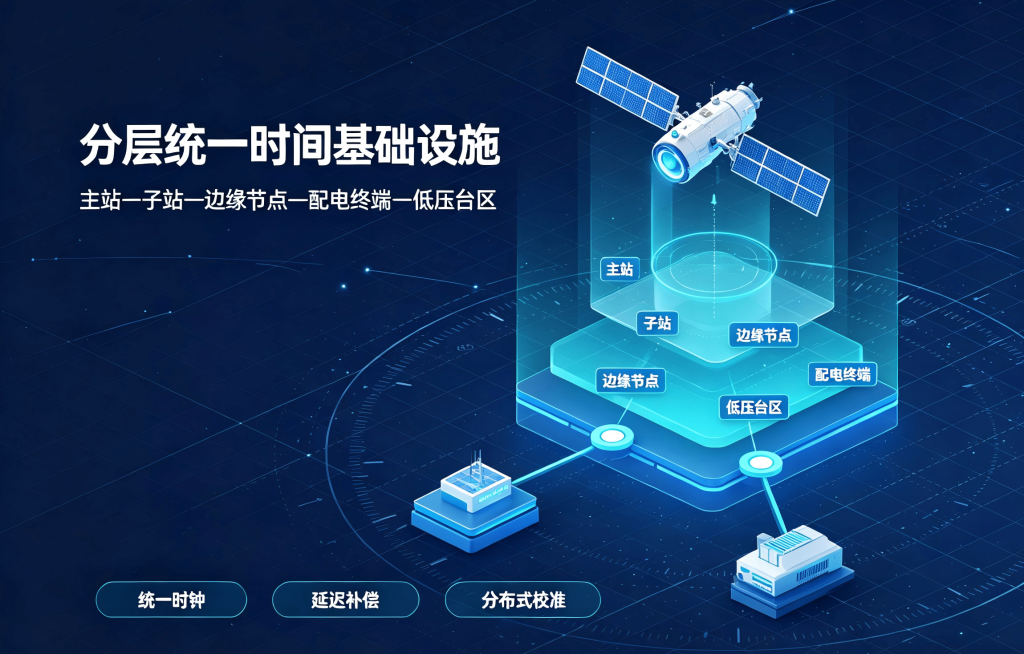
Time synchronization in distribution grids is not merely about synchronizing the time on the master server—it is a layered, unified time infrastructure spanning “master station—substation—edge node—distribution terminal—low-voltage feeder.” It resolves timing discrepancies caused by a large number of locations, multiple communication links, and distributed access.
Why Do Distribution Networks and End-Point Automation Need Unified Time Synchronization?
The challenge of time synchronization in distribution grids does not lie in “accuracy within a single substation,” but rather in “time consistency among tens of thousands of terminals across a region.” Each step of the core fault-handling process—fault detection, section localization, isolation, and restoration—relies on event assessments based on coordinated reports from multiple terminals.
Widespread, Diverse, and Large-Scale End-User Base
FA Fault Localization Depends on Event Timing
The timing of connecting distributed generation, loads, and storage is complex
Multiple communication links require tiered, controlled distribution
Typical Distribution Grid Systems and Time-Synchronization Targets
Types of devices commonly used for time synchronization in distribution networks and terminal automation, their hierarchical levels, and recommended time synchronization methods.
| Power System Levels | Typical Equipment and Applications | Time Synchronization Requirements | Synchronous Interface Types |
|---|---|---|---|
| Main Site Layer | Power Distribution Automation Master Station / Database / Emergency Repair Command Platform / Secure Access Gateway | NTP / PTP | RJ45 |
| Subsite Level | Equipped with a substation / switching station / communication gateway / regional edge time server | Secondary NTP / IRIG-B | RJ45 / BNC |
| terminal layer | FTU / DTU / TTU / Pole-Mounted Switch / Ring Main Unit / Converged Terminal | NTP / Serial Messages | RJ45 / RS-485 / 4G/5G |
| Low-Voltage Feeder Area | Smart Meters / Data Acquisition Terminals / Distributed Solar Power / Energy Storage / EV Charging Station Monitoring | Concentrator Time Synchronization / NTP | RS-485 / Carrier Current / RJ45 |
Typical Business Scenarios in Distribution Networks
Unified time synchronization across three core operational scenarios in the distribution grid, covering fault handling, analysis of automated actions, and substation operation and maintenance.
The Time Path of a Feedline
Organize business scenarios based on the path relationships among the main station, sub-stations, edge nodes, and substation terminals to demonstrate that the distribution network is not a single-point timing system, but rather a unified time-base network that spans multiple levels, links, and terminals.
Level 4:Main Site / Sub-site / Edge / Substation Terminal Layered Coverage
Category 5:Fiber Optics, 4G/5G, Carrier, RS-485, and Ethernet Coexist
Closed-loop:Unified Management of Fault Events, Link Status, and Time Synchronization Failures

The Time Path of a Feedline
Organize business scenarios based on the path relationships among the main station, sub-stations, edge nodes, and substation terminals to demonstrate that the distribution network is not a single-point timing system, but rather a unified time-base network that spans multiple levels, links, and terminals.
Level 4
Category 5
Closed-loop
Main Site Side
Establish a unified regional time portal.
Power Distribution Automation Master Station
Emergency Repair Platform
Subsite Side
Shorten the wide-area time synchronization path.
Electronics Station
Switchyard
Feeder Side
Make the FA action sequence replayable.
FTU / DTU
Edge Gateway
Substation Side
Standardize the low-voltage side statistics window.
TTU / Smart Meter
Solar Power / Energy Storage / Charging Stations
Recommended Overall Architecture
The unified time source solution for distribution grids and terminal automation employs a hierarchical network architecture featuring "centralized time synchronization from the master station + distribution via sub-stations/edge relays," which addresses the challenge of time synchronization over long links in widely distributed networks.
| Primary Source | Beidou / GNSS satellite signals, primary and backup master clocks, local rubidium clock or OCXO for time keeping | NTP / PTP | Main Data Center |
|---|---|---|---|
|
Primary Source |
Beidou / GNSS satellite signals, primary and backup master clocks, local rubidium clock or OCXO for time keeping |
NTP / PTP |
Main Data Center |
|
Secondary Aggregation |
Equipped with electronic stations, key switching stations, county-level aggregation nodes, and edge time servers |
Secondary NTP |
Fiber Optics / Private Networks |
|
Level 3 Terminal |
FTU, DTU, TTU, ring main unit, pole-mounted switch, converged terminal |
NTP / Serial Port |
4G/5G / RS-485 |
|
Closed-Loop Operations and Maintenance |
Primary/Standby Status, Edge Server Synchronization Status, Terminal Time Synchronization Failure, Communication Link Interruption |
SYSLOG / SNMP |
Distribution Network Operations and Maintenance Platform |
Design of Tiered and Graded Time Allocation
Covering a range of tens of kilometers and involving tens of thousands of nodes, the solution emphasizes a hierarchical structure comprising master stations, slave stations, edge devices, terminals, and sub-stations, thereby avoiding the latency and congestion caused by all terminals accessing the master clock directly across a wide area network.
Installation Guidelines
First, identify a unified regional time source, then cascade it down through the levels of counties, switching stations, feeder lines, and service areas to prevent end-user terminals from directly accessing the master clock across regions.
Backbone
Edge
Existing stock
Source Layer
Beidou/GNSS, the primary and backup master clocks, and the local time-keeping system are integrated to form the master station reference.
Master NTP/PTP
Aggregation Layer
In conjunction with electronic substations and switching stations, they handle power distribution at the county or regional level.
Secondary NTP
Edge Time Server
Automation Layer
Terminals involved in fault handling prioritize ensuring millisecond-level event timestamps.
FTU / DTU / TTU
Converged Terminal
Operations Layer
Acceptance criteria include coverage, deviation, link interruptions, and alert records.
Distribution Network Operations and Maintenance Platform
Primary-Standby Redundancy, BeiDou Priority, and Edge Timekeeping
Power Distribution Automation Systems Should Not Rely on a Single Clock Source
Power Distribution Automation Systems Should Not Rely on a Single Clock Source
If the time source happens to malfunction during a distribution network fault, not only will fault analysis be affected—but the fault resolution itself may fail due to incorrect timing judgments in the FA logic. The extensive scope and complex communication characteristics of distribution networks require a higher level of reliability in their design.

Primary Site Redundancy and Beidou Priority:Redundant master clock (A+B), dual power supplies, and dual GNSS systems, with priority given to the BeiDou navigation system, ensuring the robustness and reliability of the master station's source.
Edge Local Timing Strategy:When the fiber-optic connection between a substation or switching station and the master station is interrupted, the edge time server uses its built-in OCXO to continue providing NTP to local terminals, ensuring that local timing remains stable during the communication outage.
Seamless Local Timekeeping:After GNSS signal loss, the system automatically enters a time-keeping mode to ensure the time continuity of distribution network event records (FA logs, emergency repair events).
Status Visible Across the Entire Network:From the master clock to the time synchronization status of critical terminals, each level is integrated into the distribution network operations and maintenance platform via SNMP/Syslog, completely eliminating the "time black box."


Highly Reliable Timing Architecture for Distribution Networks
Primary Site 1 + 1 Mutual Backup:
The two units perform real-time mutual monitoring; in the event of an anomaly, one unit automatically takes over all link transmissions from all substations.
Keeping Time on a Remote Island:
When the uplink is interrupted, the edge server independently maintains time synchronization with local terminals.
Latent Fault Alerts:
The terminal proactively reported a time synchronization failure caused by 4G jitter as a preventive measure.
Recommended Time Synchronization Methods and Interface Matrix
Distribution grids place greater emphasis on compatibility with a large number of end devices, hierarchical distribution, and edge timing, with timing protocols tailored to nodes operating under different communication conditions.
| Primary Source | Beidou / GNSS satellite signals, primary and backup master clocks, local rubidium clock or OCXO for time keeping | NTP / PTP | Main Data Center |
|---|---|---|---|
|
Dedicated Fiber-Optic Network |
Main Station / Substation / Switching Station / Core-Edge Node |
NTP / PTP / Secondary NTP |
The link is stable and suitable for serving as a primary timing distribution path. |
|
4G/5G Private Networks |
Wireless Access FTU / DTU / TTU |
NTP / Edge Relay |
It is necessary to consider both the path length and the deviation in conjunction with the edge server. |
|
Carrier / RS-485 |
Smart Meters / Data Acquisition Terminals / Existing Low-Voltage Equipment |
Concentrator Time Synchronization / Serial Port Messages |
Address the issue of legacy terminals that do not support network NTP. |
|
Alarm Channels |
Master Clock / Edge Server / Distribution Network Operations and Maintenance Platform |
SYSLOG / SNMP / Hardware Contacts |
Used for reporting terminal time synchronization failures, link interruptions, and timing tolerance violations. |
Customer Value in Distribution Grid and End-Point Automation Scenarios
Fault location and section identification are more reliable
Timestamps for fault events at the main site, sub-sites, and FTUs/DTUs are standardized; the time data for FA logic inputs has no system deviation; the isolation range is more precise; and power restoration is faster.
Alignment of Distributed Generation, Load, and Storage Connection Events
Operational events related to photovoltaic systems, energy storage, and charging stations within the substation area are uniformly synchronized. The root causes of voltage fluctuations are documented and traceable, providing an accurate temporal evaluation basis for virtual power plant dispatch.
Unified Sorting of Main Site, Sub-Site, and Terminal Events
System-wide events are displayed across all levels on a single timeline. Users can intuitively compare and correlate power outages, switch operations, and communication interruptions.
Traceability of the Feeder Automation Operation Process
Every action taken by each terminal throughout the entire FA fault detection, isolation, and recovery process is precisely timestamped. The process can be replayed and verified node by node along a timeline, supporting policy optimization.
Distribution Network Communication Operations and Maintenance Logs Are More Accessible
The log times for communication gateways, edge gateways, and secure access gateways are synchronized, allowing for precise recording of the start and end times of link failures and more accurate statistics on the availability of distribution network communications.
A More Solid Basis for Acceptance Testing of Distribution Network Automation
Comprehensive documentation is generated from the main server’s NTP synchronization, edge server status, and terminal time deviation records. This provides verifiable evidence for the time-specific inspections conducted during automated acceptance testing.
There Is a Basis for Assessing Substation Line Losses and Electricity Consumption
The time deviation between TTU and smart meters has been reduced to the second level, ensuring that the electricity supplied and consumed truly correspond to the same time window, resulting in more reliable conclusions regarding the identification of high losses and the analysis of electricity theft.
More Clear Recovery and Performance Analysis
Precise tracking of the entire process, from fault detection to dispatch, on-site arrival, and restoration of power. This provides a solid foundation for calculating SAIDI/SAIFI reliability metrics and ensures a more equitable assessment of emergency repair efficiency.
Compatibility with existing terminals reduces retrofitting costs
By synchronizing time via the edge gateway's time relay and serial port messages, legacy terminals that support only carrier-based or serial communication can be seamlessly integrated into a unified time system, thereby protecting existing investments.
Implementation and Delivery Process
What is delivered is not a single clock device, but a full-link, layered time infrastructure that spans “master station—substation—edge node—power distribution terminal—low-voltage feeder area” and is capable of testing, acceptance, and operation and maintenance.
Main Site Confirmation
Organize the main site’s time sources, databases, FA servers, and emergency repair platform to establish a unified reference point.
Subsite Integration
Deploy secondary NTP servers by county or at key switching stations, and clearly define the uplink and local service coverage areas.
Edge Deployment
Configure edge time servers in ring main units, service areas, and critical branches to provide local time synchronization.
Random Sampling of Terminals
Group and sample deviations by FTU, DTU, TTU, and low-voltage substation to verify the consistency of FA events.
Operations and Maintenance Integration
Integrate primary/standby status, link interruptions, and terminal synchronization failures into the distribution network operations and maintenance platform.
Frequently Asked Questions
Will there be significant delay in NTP synchronization for distribution network terminals using 4G/5G communication?
NTP synchronization delays in 4G/5G networks typically range from tens to hundreds of milliseconds, which is sufficient for fault location in distribution grids (where second-level accuracy is usually adequate), as well as for calculating line loss in service areas and recording load data. For scenarios requiring higher precision (such as recording feeder automation events), it is recommended to deploy a local NTP time server as a relay at the substation or edge gateway level to reduce the impact of public network link jitter. The specific deployment method should be evaluated based on on-site communication conditions and service accuracy requirements.
Given the large number and widespread distribution of terminals in distribution grids, how can time synchronization be deployed on a large scale?
A tiered and hierarchical strategy is adopted: redundant master clocks are deployed at the power distribution master station or core substations as primary time sources; secondary NTP time servers are deployed at critical substations and in areas with a high concentration of ring main units; and terminals such as FTUs, DTUs, and TTUs obtain time from higher-level time servers via the NTP protocol. For legacy terminals that do not support NTP, they can be integrated via protocol converters or serial port message adapters. The solution supports phased implementation to gradually increase time synchronization coverage among terminals.
Why does fault location in distribution networks rely on a common time reference?
When a fault occurs on a distribution network line, multiple FTUs/fault indicators along the line record the exact times when the fault current appears and disappears. If the timestamps from the various terminals are inconsistent, determining the fault section—by comparing which adjacent terminal detected the fault current first—will result in discrepancies, leading to incorrect fault location assessments. After synchronizing the time, the fault records from all terminals can be placed on a single timeline for precise comparison.
What new requirements arise for time synchronization when distributed PV and energy storage systems are connected to the distribution grid?
Equipment such as grid-connected inverters for distributed PV and energy storage, power quality monitoring systems, and anti-islanding protection devices must be time-synchronized with the distribution network master station. In particular, the synchronization of energy storage charging and discharging sequences with the load in the transformer district is critical; without a unified time reference, it is impossible to accurately assess the actual effectiveness of energy storage in regulating peak and off-peak loads in the transformer district. Furthermore, power dispatch instructions for distributed energy sources (extensions of AGC/AVC) also require a reliable time reference.
Obtain a Time Synchronization Solution for Distribution Automation
From the power company’s data center to pole-mounted switches dozens of kilometers away, from dedicated fiber-optic networks to 4G wireless channels, from the FA’s core DTU to smart meters in service areas—the timestamps recorded by every piece of equipment can be traced back to the same reference point, and every fault isolation and restoration has a precise timeline that can be verified. and every time synchronization failure at the endpoints triggers a traceable alert on the operations and maintenance platform.
When submitting the list, it is recommended that you include:
- Distribution Network Size (Number of Feeder Lines/Service Areas)
- Terminal Types and Quantities (FTU/DTU/TTU/Converged Terminals)
- Communication Methods (Fiber Optics/4G/5G/Carrier)
- Does this involve the connection of distributed energy resources?
- Is there already a power distribution automation master station?


 简体中文
简体中文  English